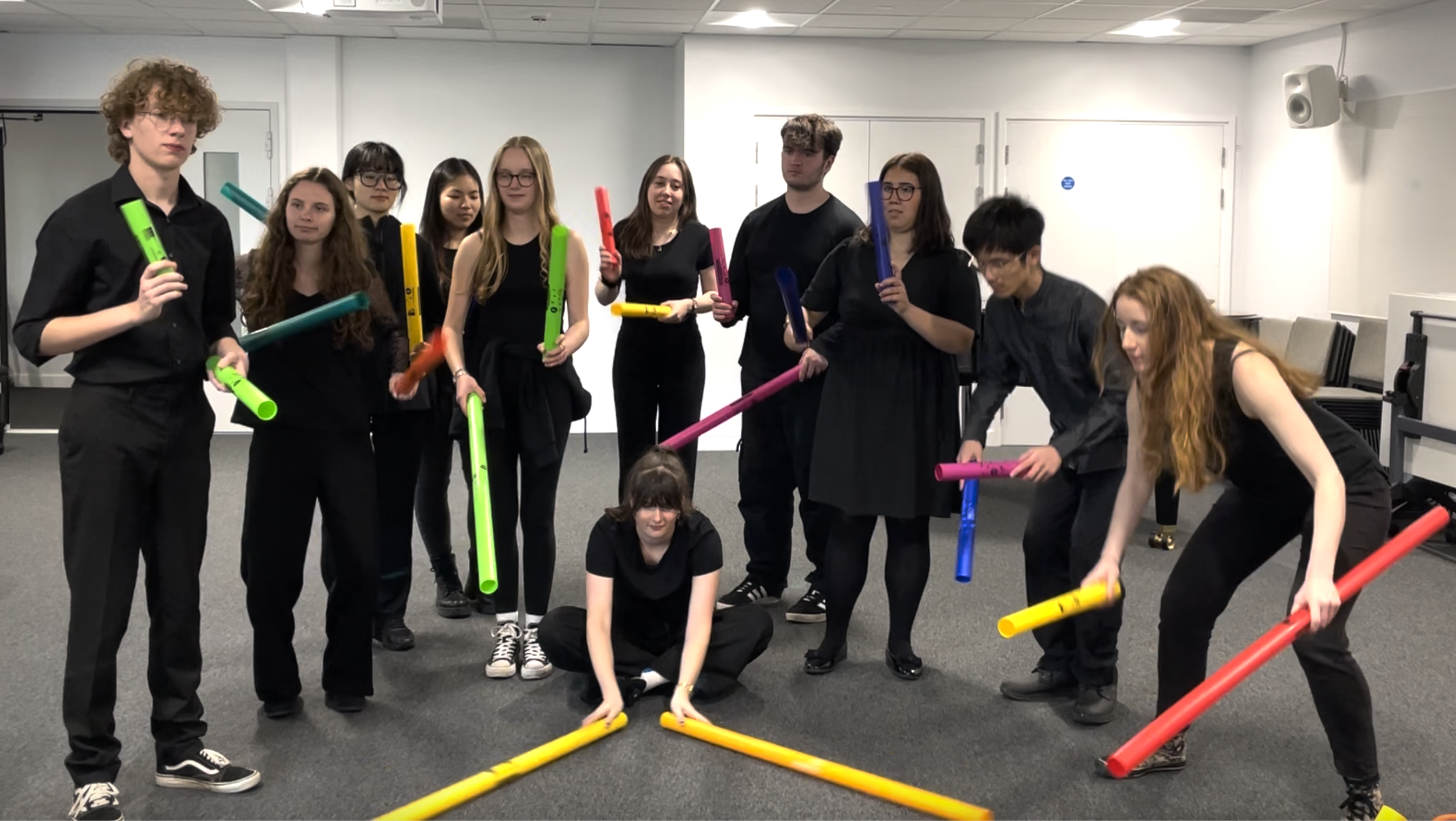
Improvising Activities
Improvisation is music being created and performed at the same time. It is spontaneous and happens in real time. While still being a creative process, it differs from composition in that the ideas are not reworked or revised; when it’s done, it’s done!
The key to successful improvising lies in working with the musical knowledge and understanding that your students have at that point – helping them to ‘use the tools in their toolbox’. Their improvisations will be influenced and informed by their musical experiences to date, their musical likes and dislikes and their instrumental handling skills. Rhythm is likely to be the main musical focus in Boomwhacker® improvisation, followed by timbre and dynamics.
Improvising within a given structure
As students become more confident creating their own improvisations, try this activity about organising and shaping their ideas into longer pieces and established musical structures.

Rondo
Number of participants: 3 or more
Tubes needed: Pentatonic scale – C, D, E, G, A, C. Any one or two each.
A rondo is a musical structure that keeps returning to an initial idea with contrasting sections in between. Those sections can be represented by letters, e.g. A B A C A.
Begin by teaching a short ostinato pattern (A). It can be as simple as four crotchet beats or be more complex rhythmically. Using Boomwhackers® from the pentatonic scale will mean that all can be played simultaneously and will sound good together.
Everyone plays the ostinato (A) together, then each new section that follows is an improvisation, with a return to the ostinato after each one.
The length of each section will be determined by the experience of the players. Begin with short ‘spaces’ – perhaps 4 or 8 beats for improvisation and then extend the length as confidence grows.
Options for sections B, C, D, etc:
Go round the players individually to improvise a solo to create new sections. Alternatively, improvise in twos, if students are apprehensive about playing as a soloist.
Have the improvisation sections in colour groups, e.g. all the green tubes improvise together.
Improvise as a larger group combining different colour Boomwhackers®, e.g. red and green improvise in Section B, or orange and purple improvise Section C.
End the piece with a single chord, using any/all of the notes.
Extend
Increase the complexity of the ostinato by adding more layers. This can be extra layers of pitch, i.e. all play the same rhythm but on a group of different pitches, or it can be extra layers of rhythm, where the same pitches play two or three different rhythms.
Or you can combine both of the above and move the ostinato between different colour groups!
N.B. If the ostinato is passed between the different colour groups, it becomes a Ritornello rather than Rondo, as the key of the ostinato has been changed.