
Playing Activities
Adapting and Accompanying Songs
Some of our really simple warm-up songs, especially call and response songs, can be adapted for Boomwhackers® to produce some quite complex pieces. When using songs in this way, make sure that they are sung regularly in warm-ups or for fun – students need to know the song really well. In this example, the Boomwhackers® take the place of particular phrases or sections..
Try replacing words or actionsThe Wheels on the Bus
Number of participants: 1 or more
Tubes needed: Any
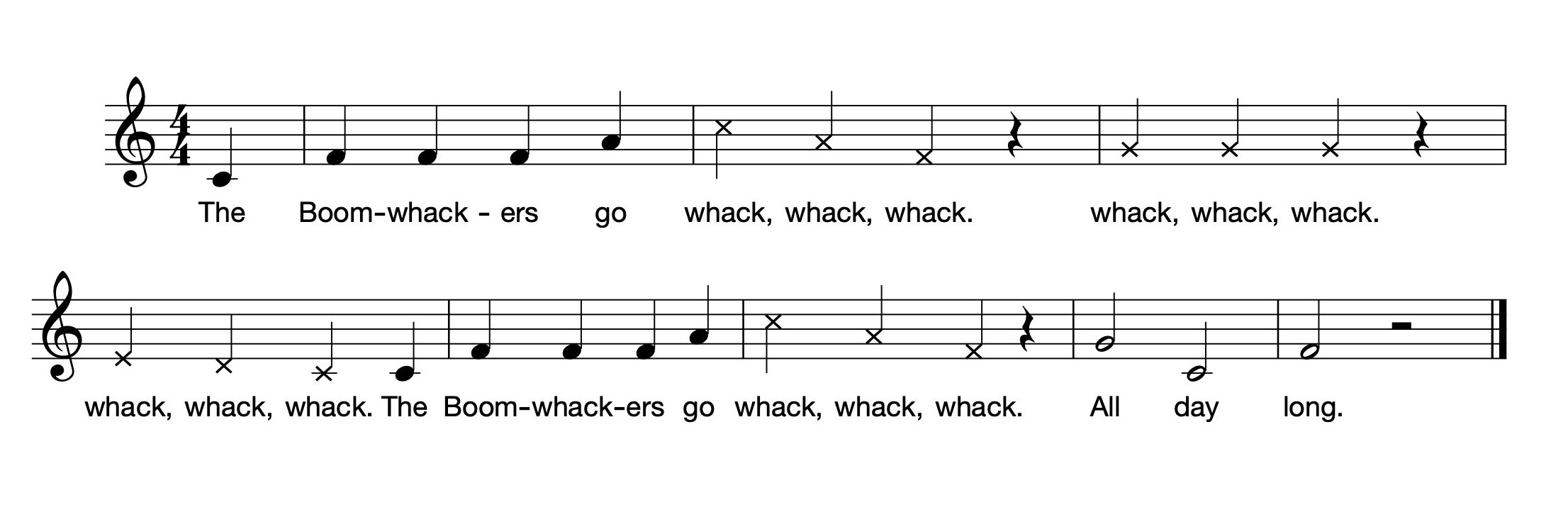
Change the words and play the Boomwhacker® on the words ‘whack, whack, whack’:
The Boomwhackers® go whack, whack, whack,
Whack, whack, whack,
Whack, whack, whack.
The Boomwhackers® go whack, whack, whack,
All day long.
Try also:
The big red tube goes whack, whack, whack, etc.
The yellow tube goes whack, whack, whack, etc.
The little green tube goes whack, whack, whack, etc.
All three tubes go whack, whack, whack, etc.
Bungalow
Number of participants: Medium/large group
Tubes needed: Any, but notes of one chord, (e.g. C, E, G, Bflat) sound good. One or two each.
1. Sing the song regularly as one of your warm-up or fun activities – students need to know the song really well.
2. Participants can have one or two Boomwhackers® each. Notes belonging to the same chord should work well together but they can be any note, if there are not enough tubes available.
3. Everyone stands in a well-spaced circle.
4. Everyone plays their tubes on the beat as they sing the song. They can be played together or in an alternating pattern. Experiment! The starting pitch of the song will match the lowest note in the chord.
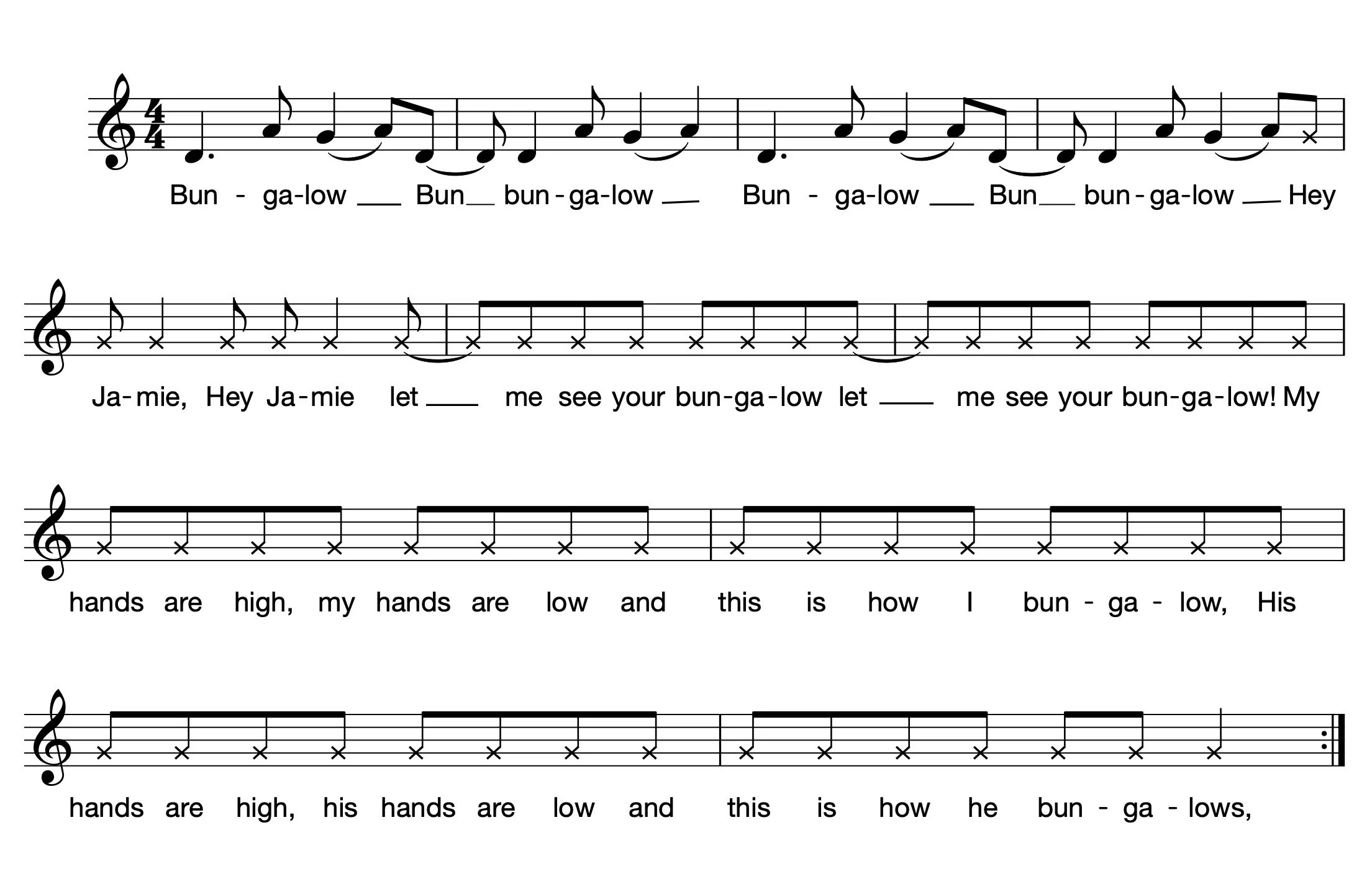
5. The playing on the beat accompanies the song up until “My hands are high”.
6. Here the group stops playing and singing, and the selected student improvises a pattern to fill the 8 beat gap.
7. The group responds doing the actions and ‘copying’ his 8 beat improvisation. (It probably won’t be exactly the same!).
8. As the song returns to the opening line again, everyone returns to playing on the beat and singing the song.
9. Encourage the use of different playing techniques in the improvisation. (It’s a great place to assess students’ knowledge of different ways that the instrument can be used).
Extend
At “Hey, Jamie, Hey Jamie, Let me see your Bungalow, Let me see your Bungalow”, an individual or a small group can play the rhythm of the words on the Boomwhacker®. This is an extension activity because the rhythm is highly syncopated and difficult to maintain against the pulse.
Layering
Layering is one of the favourite techniques used with these instruments. It’s all about texture - assembling different rhythms and pitches.
An interesting way to explore layering is to use the idea of canon. The simplest form is to play a rhythmic pattern as a round, where the parts are identical, but they start at different times. This activity uses a chant to introduce the rhythmic pattern.
Number of participants: At least 2
Tubes needed: Two different pitches that sound good together or all the same pitch – experiment! One tube each.
1. Teach students a chant, using the example here or one of your own.
2. Ask them to tap the syllables of its rhythm as they say it.
3. Then ask them to tap the rhythm while saying the words in their head.
4. Then tap the rhythm of the chant as a round, in two parts to begin with – the second part coming in one bar after the first begins. (The round can later be extended to four or more parts).
5. Transfer the rhythms to Boomwhackers®. Choose two tubes that sound good together one for each layer, or all play the same pitch.
Extend
If the round is extended to four or more parts, try using different pitches that work well together or use a pentatonic scale, where all the notes will sound good together.
Canon

Chords
Boomwhackers® can really help with chord knowledge and understanding - what they are and how to build them.
Number of participants: Large group
Tubes needed: Several diatonic sets to play these sequences in the key of C. If you have chromatic tubes, you have the option to play in keys other than C
Sit in scale order. Always have the lowest pitch on the students’ left.
Spend time creating triads (three note chords) by playing alternate notes from the diatonic scale, e.g. CEG or FAC or GBD: jumping over a note each time to create a group of notes that sound good together. Once students understand how triads are formed and have had experience of playing them, a large group can divide the chords up between themselves and play well-known chord sequences, such as: I, IV, V, I
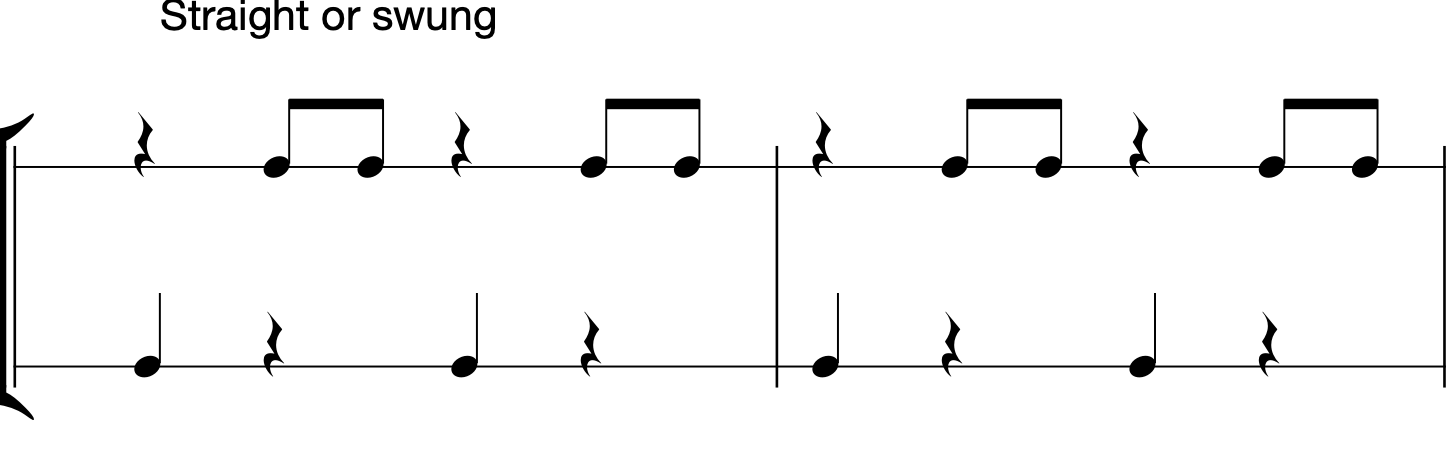
Begin by playing these sequences simply with four or eight beats to the bar, then increase the complexity of rhythms used, creating different styles, e.g. straight, rock, calypso, reggae, tango……
Bring all of these sequences to a neat end with a final tap on Chord I.
Extend
Add a bass line, or movements, or a melody over the top.
Chord sequences
Reggae